Knowledge / Solar Planning · 9 November 2026
Solar daytime loads vs battery backup: why one system size does not answer both questions
A household's monthly electricity units, daytime consumption and power-cut backup requirements describe different problems. Here is how to separate them before asking an installer for a solar and battery proposal.
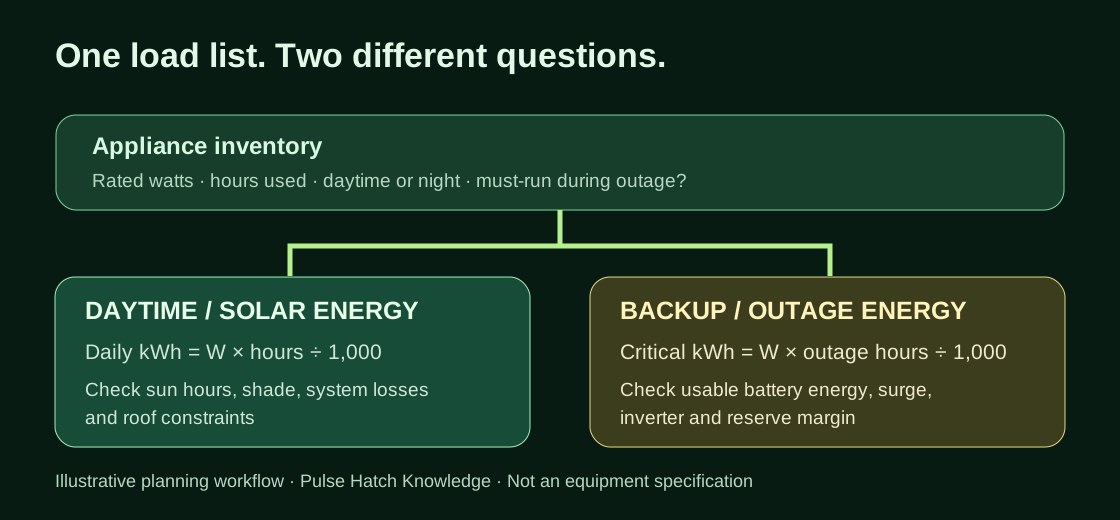
Start with three units, not a package name
Watt (W) is instantaneous power. Kilowatt (kW) is 1,000 W. Kilowatt-hour (kWh) is energy used over time. A 100 W appliance operating for five hours uses 0.5 kWh, ignoring variations in actual power. A 5 kW inverter is not automatically a five-hour backup system; inverter power and battery energy are separate specifications.
Monthly bill units are generally kWh consumed over the billing period. Dividing 450 kWh by 30 days gives an illustrative average of 15 kWh/day, but not the hour-by-hour pattern. Air conditioning, pumps and other intermittent loads can cause peaks that this average hides.
Worked example: one house, two calculations
Suppose a homeowner lists the following illustrative appliances. These are teaching assumptions, not measured ratings or recommendations for a real property.
| Appliance | Power | Normal daily use | Daily energy |
|---|---|---|---|
| Four fans | 4 × 60 W | 8 h | 1.92 kWh |
| Six LED lamps | 6 × 10 W | 5 h | 0.30 kWh |
| Television | 100 W | 3 h | 0.30 kWh |
| Router | 15 W | 24 h | 0.36 kWh |
| Total | 415 W if all on together | Different schedules | 2.88 kWh/day |
The total is 2.88 kWh per day. That does not mean the home needs a 2.88 kW solar array, nor does it mean a 2.88 kWh battery will cover every outage. Array output depends on local solar resource, roof orientation, shade, temperature, equipment and system losses. The battery must serve the particular appliances running during an outage.
Calculate the critical outage list separately
Assume a four-hour power cut and only two 60 W fans, four 10 W lights and a 15 W router must stay on. Simultaneous critical power is 175 W. Four hours at that constant load requires 0.70 kWh delivered to appliances (175 × 4 ÷ 1,000). If a purely illustrative combined discharge-path efficiency is 85%, battery-side energy would be about 0.82 kWh (0.70 ÷ 0.85), before reserve, battery operating limits, aging and any starting surge. Do not purchase a battery based on this arithmetic alone.
If the homeowner also requires a fridge, water pump or AC during outages, add realistic running power, duty cycles and starting/surge requirements. A motor can require considerably more momentary power than its steady running value, so inverter suitability cannot be inferred from daily kWh alone.
Daytime solar use changes the economics
Two houses with the same monthly bill can have different self-consumption. One uses most electricity while the sun is shining; another uses it after sunset. Without a battery or other load shifting, surplus midday generation and evening consumption do not occur at the same time. Grid export, billing credits and interconnection depend on the applicable utility rules and tariff at the time of installation; do not assume a particular export arrangement or payback figure.
Ask for hourly or at least daytime-versus-evening load estimates. Also ask whether the objective is bill reduction, outage resilience, or both. Those objectives can lead to different equipment choices.
Seven checks before requesting a quotation
- Collect 12 months of electricity units if available; note seasonal variation rather than relying on a single bill.
- List appliance nameplate watts, quantity and realistic hours of use, separating daytime and night schedules.
- Mark critical outage loads and the number of backup hours needed.
- Identify high-starting-current devices and any appliances that should remain off backup.
- Document usable roof area, shade, orientation, access and structural concerns for installer inspection.
- Ask the supplier to state usable battery capacity, permitted depth of discharge, inverter limits, warranties and safety/protection assumptions.
- Request an itemised, dated quotation with energy-yield assumptions, installation scope, exclusions and the current local interconnection requirements.
Engineering boundary: This article explains planning arithmetic, not electrical design. Roof structure, DC protection, earthing, wiring, isolation, fire safety and utility approval require qualified professionals and applicable standards.
Frequently asked questions
Can I size a battery from monthly electricity units?
Not reliably. Monthly units describe total energy, whereas backup depends on critical appliance power, run time, usable battery capacity, inverter losses and surge requirements.
Does a 5 kW solar system mean 5 kWh of energy every hour?
No. kW is a rated power figure under specified conditions; actual energy production varies throughout the day and with weather, shade and system performance.
Should every appliance be connected to backup?
Not necessarily. A dedicated critical-load circuit can reduce required battery and inverter capacity, but its electrical design and changeover protection must be professionally specified.
What if my bills do not show hourly consumption?
Use a careful appliance schedule as an initial estimate, then refine it with meter or monitoring data where practical. Clearly label assumptions.
Is the solar calculator a final installation design?
No. It helps organise planning inputs and compare assumptions. An installer or engineer must verify actual site and equipment requirements.
Sources and further checking
For general photovoltaic performance and system-loss concepts, see the U.S. National Renewable Energy Laboratory's PVWatts calculator. For general solar-and-storage consumer education, see the U.S. Department of Energy solar energy guidance. These are educational references, not Pakistan-specific tariff or regulatory approvals.
Put your own numbers into a planning worksheet
Use the Pulse Hatch Solar Calculator to explore energy, loads and equipment assumptions, then take the results to a qualified local installer for verification.
Open Pulse Hatch Solar Calculator →Read the solar calculator manual · Understand bill-based solar sizing · Browse Knowledge