Solar Engineering • Bill Sizing Formula • Pakistan 2026
Bijli ke Bill se Solar System ka Size nikalne ka Asan Tareeqa (Pakistan 2026 Guide)
Updated: 17 November 2026 • Verified by Pulse Hatch Solar Engineering Desk
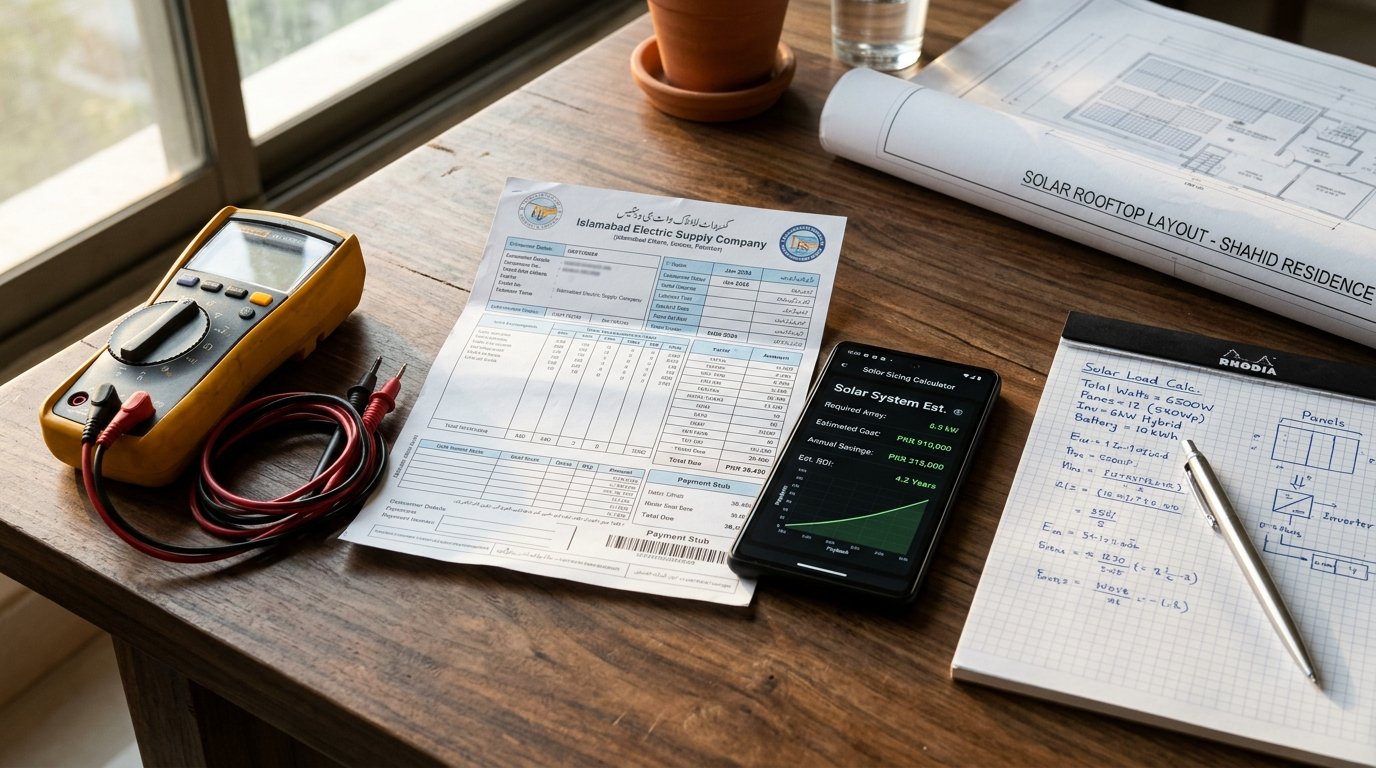
Apne WAPDA (IESCO, LESCO, MEPCO, FESCO) ya K-Electric bill ke mahana units dekh kar exact solar system size (kW), plates ki tadaad aur inverter capacity nikalna seekhein. Is practical engineering guide me 12-month billing audit, peak sun hours aur roof space ka mukammal hisab wazeh kiya gaya hai.
Language Mode:
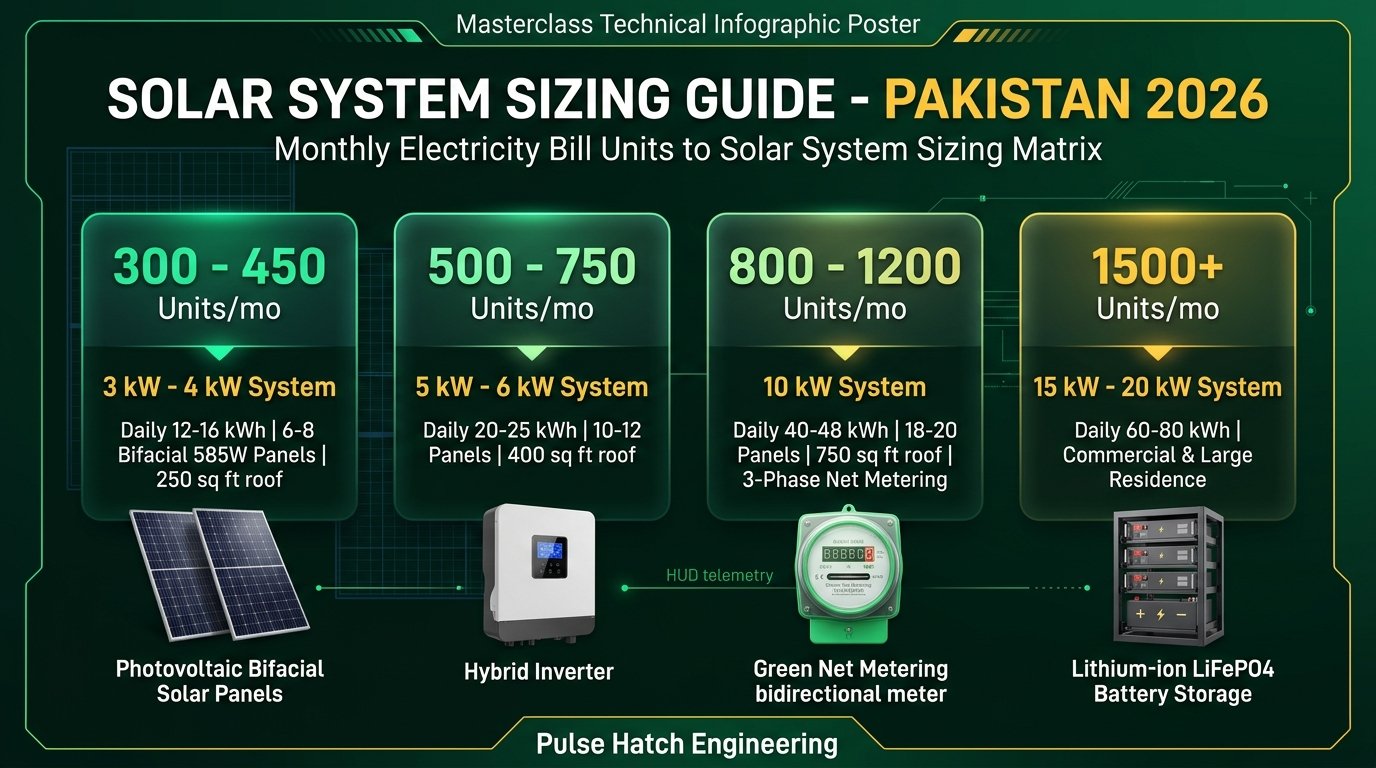
Figure 1: Pulse Hatch technical matrix mapping monthly electricity consumption tiers to solar capacity, panel count, and roof area.
1. Apne Bijli ke Bill (WAPDA / K-Electric) se Sahi Data Hasil Karein
Aksar log sirf pichhle mahine ka bill dekh kar faisla karte hain jo ke intehai ghalat tareeqa hai. Solar ka size tay karne ke liye bill par ye 3 cheezein lazmi note karein:
📊 1. 12 Mahine ki Billing History (Unit Consumption Graph):
Bill ke peechhe ya samne pichhle 12 mahino ke units likhe hote hain. Pakistan me sardiyon (December, January) me 150-250 units ate hain jabke garmiyon (June, July) me AC chalne ki wajah se 600 se 1000 units ban jate hain. Sizing hamesha Summer Peak Consumption ko madde nazar rakh kar ki jati hai.
⚡ 2. Sanctioned Load (kW):
Aapke bill par likha hota hai ke aapka connection kitne kW ka hai (maslan 3 kW ya 5 kW). Agar aap On-grid Net Metering karwana chahte hain to NEPRA ke mutabiq aapka inverter aapke sanctioned load ke 1.5 gunnah se bara nahi ho sakta. Maslan 5 kW sanctioned load par maximum 7.5 kW ka inverter lagega.
⏱ 3. Peak vs Off-Peak Units:
Agar aapka 3-phase digital meter hai to shaam 6 se 10 baje (ya 7 se 11 baje) Peak Hours hote hain jinka unit rate double hota hai. Solar din ke waqt Off-peak units ko export karta hai jo Net Metering billing me adjust hote hain.
2. Solar Sizing ka Asal Engineering Formula
Pakistan ke climate me 1 kW solar panels rozana ausatan 4 se 4.5 units (kWh) bijli banate hain. Pure mahine me 1 kW system taqreeban 120 se 130 units paida karta hai.
🔢 Step-by-Step Calculation Formula:
Step 1: Apne garmiyon ke mahana units note karein (Misal: 600 Units). Step 2: Rozana ki consumption nikalein = 600 ÷ 30 = 20 Units (kWh) rozana. Step 3: Pakistan ke Peak Sun Hours = Ausatan 4.8 Hours. Step 4: System Efficiency (Losses, Dust, Temperature Derating) = 80% (0.80). Calculation: (20 ÷ 4.8) ÷ 0.80 = 5.2 kW. Nateeja: Aapke ghar ke liye 5 kW ya 6 kW ka solar system bilkul perfect hai!
Figure 2: Modern residential rooftop solar array featuring high-efficiency bifacial panels tilted south for maximum annual yield.
3. Mahana Units vs Solar System Sizing Table (2026 Pakistani Homes)
Apne monthly units ke mutabiq fori check karein ke aapko kitne kW system, kitni plates aur kitni chhat ki zaroorat hai:
Mahana Units (Bill)
Recommended System
Plates Tadaad (585W Bifacial)
Required Roof Space
Kya Load Chal Sakta Hai?
300 se 450 Units
3 kW - 4 kW
6 se 7 Panels
~250 sq ft
1 Inverter AC (din me), Refrigerator, Fans, Water Pump, LED Lights
500 se 750 Units
5 kW - 6 kW
9 se 11 Panels
~400 sq ft
2 Inverter ACs (din me), Fridge, Iron, 1 HP Motor, All Home Lights/Fans
800 se 1,200 Units
10 kW System
17 se 18 Panels
~750 sq ft
3-4 Inverter ACs, Deep Freezer, 1.5 HP Borehole Pump (Net Metering Recommended)
1,300 se 1,800 Units
15 kW System
26 se 28 Panels
~1,100 sq ft
1 Kanal Kothi / Joint Family: 5-6 ACs, commercial loads, near zero WAPDA bill
2,000+ Units
20 kW+ System
35+ Panels
~1,500+ sq ft
Bari Commercial Buildings, Plazas, Farms, Industrial Connections
☀️ Chhat (Roof) ki Sharaait:
Har 1 kW solar system ke liye taqreeban 70 se 80 square feet saaf chhat chahiye jahan subah 9 baje se shaam 4 baje tak koi saya (shadow) na ata ho. Plates ka rukh hamesha South (Junoob) ki taraf 28° se 32° angle par hona lazmi hai.
4. On-Grid vs Hybrid Inverter: Konsa Select Karein?
Pakistani market me 3 aqsam ke inverters aam tor par use hote hain:
On-Grid (Grid-Tied) Inverter: Ye inverter seedha WAPDA grid ke sath sync hota hai aur Net Metering ke zariye units export karta hai. Isme batteries ki zaroorat nahi hoti aur ye sab se sasta aur long-lasting hota hai. Lekin agar WAPDA ki bijli chali jaye to safety (anti-islanding) ki wajah se ye band ho jata hai.
Hybrid Inverter (with Lithium/Tubular Battery): Agar aapke ilaqay me loadshedding hoti hai to Hybrid inverter behtareen hai. Ye din me Net Metering bhi karta hai aur loadshedding ke waqt battery se ghar ke zaroori loads (AC, fans, fridge) chalata hai.
Off-Grid Inverter: Jahan grid mojood na ho (Dehat ya farmhouse) wahan sirf panels aur battery bank par kaam karta hai.
❌ Solar Sizing me 3 Baray Nuqsanat jinse Bachna Hai:
Sardiyon ke bill par sizing karna: Sardiyon me 200 units atay hain to log 3kW laga lete hain, phir garmiyon me jab 700 units atay hain to WAPDA ka bhari bill ana shuru ho jata hai.
Panel ki quality me compromise: Tier-1 Bloomberg certified N-Type TOPCon ya Bifacial panels (Jinko, Longi, JA Solar, Canadian) hi khareedein. Grade-B panels garmiyon me 45°C par bijli 30% kam banate hain.
Earthing Pit na lagwana: Solar frame aur inverter ke liye 5 Ohms se kam resistance wali earthing zaroori hai, warna aasmani bijli ya voltage surge se inverter jal sakta hai.
Apne Bill ke Units se Instant Solar Sizing Check Karein
Pulse Hatch Solar Calculator me apne pichhle mahinay ke units ya average units dalein aur fori dekhein ke aapko kitne kW system, plates aur inverter ki zaroorat hai.
Pakistan me saalana ausatan 1 kW solar panels rozana 4 se 4.5 units banate hain (garmiyon me 5 units tak aur sardiyon me 3.5 units tak). Pure saal me 1 kW taqreeban 1,450 se 1,550 units paida karta hai.
Kya 5 kW solar system par 1.5 ton ka Inverter AC chal sakta hai?
Jee bilkul! Ek 5 kW solar system din ke peak waqt 3,800 se 4,200 watts bijli banata hai. Ek 1.5 ton inverter AC running me 1,200 se 1,500 watts leta hai. Yani aap ba-asani 2 inverter ACs din me chala sakte hain aur sath fridge aur fans bhi chalte rahenge.
Net Metering ke liye minimum kitne kW ka system hona zaroori hai?
NEPRA ke qanoon ke mutabiq residential net metering ke liye 3-phase meter lazmi hai aur aam tor par 5 kW ya us se bara system recommend kiya jata hai, kyunke 3-phase on-grid inverters aam tor par 5 kW se shuru hote hain.
1. Extracting Essential Sizing Data from Your Pakistani Electricity Bill
Sizing a solar PV array based on a single monthly bill leads to either chronic under-generation or wasteful over-capitalization. When reviewing your DISCO (IESCO, LESCO, MEPCO, K-Electric) bill, record these three parameters:
📊 1. 12-Month Consumption History:
Review the 12-month billing bar chart on the back of your electricity bill. In Pakistan, winter demand (Dec-Jan) typically drops to 150-250 kWh, whereas summer cooling demand (June-July) escalates to 600-1,200 kWh. Sizing must be anchored to Summer Peak Demand to offset high-tier tariff brackets.
⚡ 2. Sanctioned Connected Load (kW):
Indicates your authorized grid connection capacity. Under NEPRA Net Metering Regulations (SRO 892(I)/2015), the alternating current (AC) rating of your solar inverter cannot exceed 150% (1.5x) of your sanctioned load without a formal load enhancement application.
⏱ 3. Peak vs Off-Peak Rate Schedules:
Three-phase digital Time-of-Use (TOU) meters enforce punitive tariff rates during evening peak hours (typically 6:00 PM to 10:00 PM). Solar net metering exports units at the off-peak rate, offsetting daytime and night-time off-peak consumption on a 1:1 unit basis.
2. Engineering Sizing Mathematical Formula
Under Pakistan's solar irradiance profile (GHI ~5.2 kWh/m²/day), each 1 kW of installed Tier-1 solar panels yields approximately 4.0 to 4.5 kWh per day, generating 115 to 130 kWh (units) monthly.
🔢 Step-by-Step Engineering Calculation:
Step 1: Identify average peak monthly consumption (Example: 600 Units). Step 2: Determine daily kWh requirement = 600 ÷ 30 = 20 kWh/day. Step 3: Apply Pakistan's usable Peak Sun Hours (PSH) = 4.8 Hours. Step 4: Apply System Performance Derating Ratio (accounting for soiling, inverter clipping, temperature coefficient, and wire losses) = 80% (0.80). Calculation: (20 ÷ 4.8) ÷ 0.80 = 5.2 kW DC array. Conclusion: A 5 kW or 6 kW system is the exact engineering match for this consumption profile.
Figure 2: Modern residential rooftop solar array featuring high-efficiency bifacial panels tilted south for maximum annual yield.
3. Consumption Tiers vs Solar System Sizing Matrix (Pakistan 2026)
Cross-reference your monthly billing units against verified system capacity, panel numbers, and physical roof requirements:
Monthly Consumption
Recommended Solar Array
Panel Count (585W Bifacial)
Roof Area Required
Typical Appliance Capacity
300 to 450 Units/mo
3 kW - 4 kW System
6 to 7 Panels
~250 sq ft
1 Inverter AC (daytime), Refrigerator, Water Pump, Ceiling Fans, LED Lighting
500 to 750 Units/mo
5 kW - 6 kW System
9 to 11 Panels
~400 sq ft
2 Inverter ACs (daytime), 1 HP Water Pump, Refrigerator, Microwave, All Home Lights
800 to 1,200 Units/mo
10 kW System
17 to 18 Panels
~750 sq ft
3-4 Inverter ACs, Deep Freezer, 1.5 HP Borehole Pump (3-Phase Net Metering Recommended)
1,300 to 1,800 Units/mo
15 kW System
26 to 28 Panels
~1,100 sq ft
1 Kanal Residence: 5-6 Inverter ACs, extensive refrigeration, zero net billing
2,000+ Units/mo
20 kW+ System
35+ Panels
~1,500+ sq ft
Commercial plazas, hospitals, schools, and small industrial facilities
☀️ Rooftop Orientation and Shading Rules:
Every 1 kW of installed PV panels requires approximately 70 to 80 square feet of unshaded roof space. In Pakistan, panels must face True South (Azimuth 180°) at a tilt angle between 28° and 32° to optimize year-round solar capture.
4. Selecting the Right Inverter Architecture (On-Grid vs Hybrid)
Three primary inverter technologies dominate the Pakistani market:
On-Grid (String) Inverters: Synchronize directly with the utility grid and export excess power via bidirectional Net Metering. They represent the lowest capital expenditure per watt with zero battery maintenance, but automatically decouple during grid blackouts for line safety (anti-islanding).
Hybrid Inverters (with LiFePO4 or Tubular Battery): The preferred choice in areas experiencing daily load shedding. They combine on-grid net metering export capabilities with instantaneous uninterruptible power supply (UPS) transfer for critical household loads.
Off-Grid Inverters: Dedicated standalone units paired with extensive battery banks for remote agricultural tubewells or farmhouses where grid infrastructure is absent.
❌ Three Critical Sizing Errors to Avoid:
Sizing to Winter Bills: Sizing for 250 winter units leaves a 5 kW deficit during June-August, generating massive tariff penalties.
Thermal Degradation Blindness: Avoid uncertified B-grade panels. Tier-1 TOPCon cells feature temperature coefficients of −0.29%/°C, retaining peak power during 45°C Pakistani summer heat waves.
Neglecting Proper Earthing Protection: Ensure dual dedicated chemical earthing boreholes (inverter body & lightning arrestor) maintain an electrical resistance of below 5 Ohms.
Calculate Your Exact Solar System Size in 60 Seconds
Input your monthly bill units into the Pulse Hatch Solar Calculator for an instant engineering assessment of required kW capacity, panel count, and annual bill savings.
How many electricity units does a 1 kW solar system generate annually in Pakistan?
A 1 kW solar array generates between 1,450 to 1,550 kWh annually in central and northern Pakistan, delivering approximately 4.0 to 4.5 kWh per day across varied seasons.
Can a 5 kW solar system run a 1.5 ton Inverter Air Conditioner?
Yes. A 5 kW array produces between 3,800 to 4,200 watts during midday hours. A modern 1.5-ton DC inverter AC consumes 1,200 to 1,500 watts, allowing you to comfortably run two inverter ACs alongside standard refrigeration and lighting loads.
What is the minimum system size required for Net Metering in Pakistan?
NEPRA regulations mandate a three-phase connection for net metering. Three-phase on-grid inverters commercially start at 5 kW, making 5 kW the practical baseline for net metering applications.