Construction · Estimating & BOQ · 8 November 2026
Construction Estimate Contingency vs Provisional Sum: A Practical BOQ Guide
An estimate can contain a well-defined measured scope, work whose price is not yet known, and a reserve for uncertainty. Treating these as one miscellaneous percentage makes contractor comparisons and change control much harder.
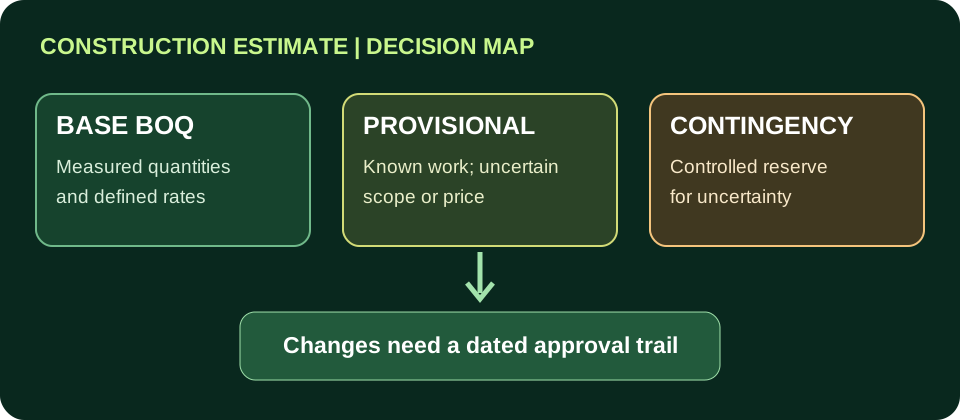
1. Three budget lines that should not be confused
Base BOQ: work that can be described and measured against drawings and specifications, such as concrete volumes, wall areas or door schedules. Each item should carry a unit, quantity, rate and scope description.
Provisional sum: an identified part of the work for which the exact specification, quantity or price is not settled at tender stage. For example, a gate system may be required but its final model is undecided. State what is included and how the allowance will be adjusted after selection. A provisional sum is not a free allowance for unrelated work.
Contingency: a separately tracked reserve for risks or uncertainties that remain after the estimate is prepared. It should not conceal known missing BOQ items or be automatically payable to a contractor. Who controls it, how it is released and whether it forms part of the contract price depend on the agreed contract.
2. A worked example using illustrative figures
Suppose a preliminary residential project has a measured base estimate of PKR 8,000,000. A specific but unselected gate package carries a provisional allowance of PKR 250,000. The owner sets aside a planning contingency of 5% of the base estimate, or PKR 400,000. These figures are hypothetical arithmetic examples, not current Pakistan construction prices or a recommended universal percentage.
| Component | Example amount | How to treat it |
|---|---|---|
| Measured base BOQ | PKR 8,000,000 | Check drawings, quantities, exclusions and rates |
| Provisional gate allowance | PKR 250,000 | Replace with an approved scope and quotation |
| Owner contingency (5% of base) | PKR 400,000 | Track separately; release only under agreed controls |
| Planning funding envelope | PKR 8,650,000 | Not automatically the contractor's fixed contract sum |
If the selected gate is approved at PKR 290,000, the provisional allowance needs a documented PKR 40,000 adjustment, subject to the contract's valuation and approval rules. That adjustment should not silently be recorded as a contingency expense or treated as a new measured concrete item.
3. Common estimating mistakes
- Double counting: adding a provisional gate allowance while also including the complete gate in the base BOQ.
- Hidden exclusions: leaving stairs, railings, electrical distribution or external drainage out of the estimate and assuming a general contingency will cover them.
- Mixing taxes and fees: failing to state whether duties, permits, professional fees and escalation are included.
- Ambiguous ownership: treating the owner's reserve as money a contractor can spend without written authorisation.
- No revision history: updating the total without preserving the original estimate, approved change and date.
4. A practical change-control workflow
- Freeze an estimate revision with drawing numbers, assumptions and dated local quotations.
- Identify each unresolved work package and give it a separate provisional-sum reference.
- Prepare a risk register describing uncertainty, likely impact, responsible reviewer and mitigation.
- When a change is proposed, issue a variation request explaining the reason, scope, quantity, rate basis and time effect.
- Approve or reject the variation through the agreed contract process before instructing work where required.
- Update the forecast using separate columns for original amount, approved changes, committed amount, remaining allowance and forecast final cost.
Engineering caution: Contract terms and procurement rules differ. This guide explains estimation concepts, not legal advice or a substitute for the applicable conditions of contract. Never use a generic reserve to justify unsafe or unapproved site changes.
5. Checklist before sharing an estimate with a client
- Are quantities tied to the latest revision of architectural, structural and MEP drawings?
- Are provisional sums named, scoped and traceable to decisions still pending?
- Are labour, materials, wastage, transport, taxes, overhead and profit assumptions clear?
- Is contingency shown separately from the contract tender comparison?
- Have stairs, railings, site works, utility connections and drainage been checked?
- Does every approved variation have a number, date, valuation and authorising party?
- Can the client distinguish the contract amount from the broader project funding envelope?
Frequently asked questions
Is contingency the same as a provisional sum?
No. A provisional sum identifies a particular known work package with an unresolved value. Contingency is a managed reserve for uncertainty and should have its own release rules.
Can a contractor claim all unused contingency?
Not merely because it appears in a project budget. Entitlement depends on the contract and approved instructions; an owner's planning reserve may sit entirely outside the contractor's contract sum.
Should I use 5% contingency on every house?
No. The 5% above is only arithmetic. The reserve should follow project maturity, risk exposure, site investigations, design completeness and the owner's risk policy.
How do I compare two quotations fairly?
Normalise scope and exclusions, compare the same measured items, identify allowances separately and record differences in tax, material specification and programme before ranking totals.
For related learning, see the BOQ missing-items checklist and the 7 Marla estimate checklist. This article is educational; it does not certify a tender, price or contract entitlement.